Category : — Statements & Letters: Bishops

How the "Anaheim Statement" Bishops Voted

This may cross over into editorializing which we elves try not to do. But posting the roll call tables below, we couldn’t help but be struck by something.

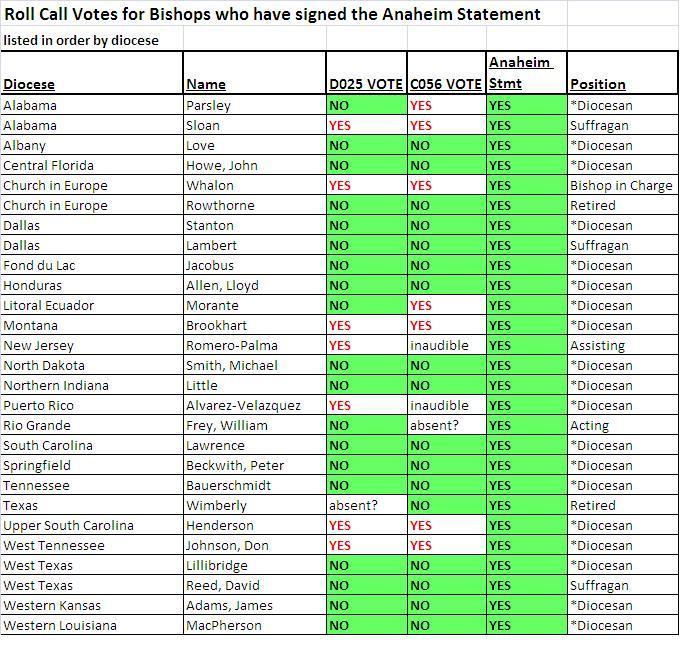
We have extracted the voting information for the 27 bishops who are known to have signed the “Anaheim Statement,” from the larger table with all the roll call votes which is posted in the entry below. It seems very strange to us elves that a full one-third of these signatories claim to “reaffirm their commitment” to uphold the Windsor Process moratoria, while they voted FOR one or both resolutions (D025 and C056) that indicate TEC’s intention to breach those moratoria.

Remember, as per all our caveats in the entry below, the vote tallies here are unofficial. Every effort has been made to ensure accuracy, but the C056 data in particular is still off by two votes (among the full 136 bishops who voted).

You can read the full text of the Anaheim Statement here

It includes the line:
* We reaffirm our commitment to the three moratoria requested of us by the instruments of Communion.

Re-read D025 and C056 for yourselves, and please explain to this feeble-minded elf how one can have voted YES for D025 and C056 and signed this reaffirmation. We’re clueless.

–Elfgirl

Posted in * Anglican - Episcopal, - Anglican: Primary Source, -- Statements & Letters: Bishops, Episcopal Church (TEC), General Convention, Same-sex blessings, Sexuality Debate (in Anglican Communion), TEC Bishops, TEC Data, Windsor Report / Process

UNOFFICIAL Tallies of Bishops' Roll Call Votes at GC09, and Anaheim Statement Signatories

Thanks to the work of a number of T19 readers, led by Karen B., here is an unofficial tally of all the Bishops’ roll call votes from GC09.

It includes the roll call votes for:

Resolution D025 (basically overturning B033 which urged restraint on consecration of further non-celibate homosexual bishops, etc.)

Rowe Amendment to discharge, (i.e. “kill without voting”) Resolution C056

Resolution C056 (allowing development of SSB liturgies and “generous pastoral response”)

— Also, the currently known signatories to the “Anaheim Statement” are noted.

The listing is based on vote by vote review of the audio files of the roll calls for D025 and C056, and also draws heavily on the Rev. George Conger’s report for the Living Church. (however the tally does not exactly match Conger’s tally. There are 3 or 4 differences based either on what was heard on audio, or other published reports of how a bishop voted.) There are detailed notes and links to sources at the bottom of the table.

Note: the totals for D025 match the published totals. However the totals for the Rowe Amendment and C056 are slightly off by 2-3 votes. There are several votes which are impossible to hear clearly in the audio files. So these tallies should be used with caution, although they are believed to be 99% accurate.

Please send Kendall or us elves any corrections. We will of course post the official tallies from TEC once they are released.

You can download/view the PDF version of the roll call tallies table here

We’re going to try to post the full table here on the blog, but that may be difficult. Check back in a little while.

Posted in * Anglican - Episcopal, - Anglican: Primary Source, -- Statements & Letters: Bishops, Episcopal Church (TEC), General Convention, Same-sex blessings, Sexuality Debate (in Anglican Communion), TEC Bishops, TEC Conflicts, TEC Data, Windsor Report / Process

The Bishop of Arkansas Saying General Convention did not do what In Fact They did

Read it all.

Posted in * Anglican - Episcopal, - Anglican: Primary Source, -- Statements & Letters: Bishops, Episcopal Church (TEC), General Convention

The Bishop of Arkansas Speaking in Favor of D025

From here:

One thing of which I stand in awe is how the early church was able to put into words God’s revelation of the Trinity and develop a creedal language 1600 years ago that has lasted down to the current age.

The revelation and the creedal language tell us of a Trinity that is mysteriously and intimately intertwined, with an unbounded reciprocal love. We do not understand its complexity, but we do see the results of that love; it is an outpouring of love for all of creation, especially an outpouring of love toward humanity, a love whose ultimate expression is in the love of Christ for humankind.

Likewise, the love of one human being for another, as creatures created in the image of God, is a complex and mysterious thing. Such love can take the form of friendship, or of what the New Testament calls agape, or of sexual love, to name but a few examples. Just as with the reciprocal love of the Trinity, we rarely understand human love, and sometimes are even frightened by it, as in the case of sexual love, because it is so personal, indeed, so intimate.

But we do see the results of such human love, as when the love of two people for one another causes them to reach out in love and concern for others. By saying that we will limit that love and concern for one another and, by extension, to others, simply on the basis of chromosomal make-up is fearful at best, and at worst a human obfuscation of the very mystery of the outpouring love of the Trinity.

I contend that we already have a theological rationale for moving forward in areas of human sexuality. In fact, we have had it for 1600 years, but only in this generation have the scales begun falling from our eyes. In ways that we frequently do not understand, we have a tangible glimpse of the divine love of the Trinity.

We need to witness to this generation, bringing good news now.

Proclaiming the good news is never a future event; it is always a present honor and responsibility. If we as bishops always want to wait for a more opportune time, I fear that we are forgetful of our ordination vow to boldly proclaim the Gospel of Christ, enlightening the minds and stirring up the conscience of our people.

Posted in * Anglican - Episcopal, - Anglican: Primary Source, -- Statements & Letters: Bishops, Episcopal Church (TEC), General Convention

The Bishop of Olympia on Resolution D025

From here:

[Greg] Rickel, in a blog on Wednesday, anticipated that the latest General Convention actions will cause some pain. “It does not go back to B033, but instead looks forward,” he said of the resolution adopted.

“Several things are important to me here. First, I think it is time for this Church to be honest about where it finds itself now. Second, it must acknowledge that not everyone is in that same place, in fact there are many and varied places people find themselves in this debate.

“Third, this resolution does, in fact, open up access once again to gay and lesbian people, to the discernment process for the episcopate. To interpret this any other way would be dishonest.”

Posted in * Anglican - Episcopal, - Anglican: Primary Source, -- Statements & Letters: Bishops, Episcopal Church (TEC), General Convention

Living Church: Dissenting Bishops Issue 'Anaheim Statement'

Twenty-nine bishops have endorsed affirming their desire to remain part of the Anglican Communion and Episcopal Church while being faithful to the calls for restraint made by the wider church.

Styled as the “Anaheim Statement,” the letter of dissent to the actions of the 76th General Convention pledged the bishops’ fealty to the requests made by the Archbishop of Canterbury, the 2008 Lambeth Conference, the primates’ meetings and ACC-14 to observe a moratoria on same-gender blessings, cross-border interventions and the ordination of gay and lesbian people to the episcopate.

In the hours after its release, the statement drew support from 23 diocesan bishops, four suffragan and assistant bishops, and two retired bishops and included bishops who voted on both sides of D025 and C056 — resolutions that rescinded the ban on two of the three Windsor Report moratoria.

Read it all.

Posted in * Anglican - Episcopal, - Anglican: Primary Source, -- Statements & Letters: Bishops, Episcopal Church (TEC), General Convention, TEC Bishops

The Bishop of Newark Offers some Reflections on General Convention 2009

We are coming into the home stretch of this General Convention. We finish late Friday afternoon. Today a balanced budget for The Episcopal Church was passed in both the House of Deputies and the House of Bishops. There were no amendments to the budget, although some were proposed in the House of Deputies. There was virtually no discussion on the budget in the House of Bishops. It was a moment of legislative whiplash which, I suppose, reflected the feeling of futility that nothing could be changed. The lack of debate also honored the extraordinary work of the Program, Budget and Finance Committee that had the onerous task of balancing the budget that at one point was $24 million dollars in deficit. Many cuts were made, which means that lots of departments across the church have been reduced; and many staff jobs have been eliminated. There is a lot of hurt and loss to all of this — and I don’t think any of us really know the implication and impact of this yet.

“Mission” is our Presiding Bishop’s echoing metaphor. She describes mission as the heartbeat of the church. She invited — no, she challenged, us to hear the mission heartbeat in our bodies and souls. It will be more imperative than ever to respond to this challenge with deeper commitment — given that there are fewer financial resources to carry it out. Thus the Episcopal Church mirrors the experience of the dioceses — which is, to be sure, also the experience of congregations.
Yesterday, the House of Bishops passed a resolution that said a whole array of things — but mainly was focused on same-gender blessings and offering generous pastoral sensitivity for dioceses which perform them. The original amendment was almost brought to a vote the day before, but several bishops who were in the minority of the two-to-one vote the day before that (on affirming GLBT people for all levels of ministry) stood up to say that they felt marginalized and vulnerable. The legislative process was abandoned for the rest of the day — and a group of self organized bishops agreed to meet informally in order to try and move things forward.

This was the hardest moment of Convention for me. It turned out that it was the hardest moment of Convention for the 26 bishops who met that night and early the next morning — and for 26 different reasons. I felt that there was a movement afoot to scrub the decision of full inclusion; others said that the church was moving too fast for them. We expressed our thoughts and feelings in an Indaba-like atmosphere (which we had learned at the Lambeth Conference a year before). As the discussion progressed, we decided to move beyond creating a process of winners and losers, and instead to intentionally come up with a statement that included the ideas and feelings of as many as possible. We wanted to build a tent that was high and wide enough for as many as possible to gather underneath.

The resulting resolution (which five of us wrote) reflected the diversity of perspectives. When presented on the floor of the House of Bishops, there were more amendments — and amendments to the amendments; but they were, for the most part, attempts to better articulate what we were about rather than efforts to discredit or distort.

The final resolution passed by a three to one margin. It recognized our diversity. Instead of trying to restrict dioceses — the intent of the resolution was to trust the integrity and practice of bishops in their respective jurisdictions.

I think it was an important step forward.

Your deputation will be coming home tomorrow — and over the weekend. Many of us from General Convention will be present next Thursday, July 23 — from 10am-12 noon, and 7pm to 9pm, at St. Agnes Church, 65 Union Avenue, Little Falls, to tell our stories of Convention and to entertain your questions and hear your concerns. Each session will essentially be the same — and anyone who wishes to is invited to come.

Peace,

–(The Rt. Rev.) Mark M. Beckwith is Bishop of Newark

Posted in * Anglican - Episcopal, - Anglican: Primary Source, -- Statements & Letters: Bishops, Episcopal Church (TEC), General Convention

The New York Times Interviews Gene Robinson

A: The most significant thing that happened was on Tuesday, after the House of Bishops stopped the debate on same-sex blessings and decided to have a smaller group of bishops meet to discuss it further. They said anyone could come, and it turned out it wasn’t a small group at all. There were 25 to 30 of us, and it turned out to be the most significant interaction I’ve had with the bishops since I’ve been elected.

It was profound and it was inspiring. People stood up and spoke their own truth, both the pain and the joy. Everyone spoke honestly about what they needed to go home with, what they could live with and what they couldn’t.

Q: So how do you explain the vote counts? The bishops passed both of these measures resoundingly, and we are starting to hear of many moderate-to-conservative bishops who voted “yes” on both ordinations and gay blessings.

A: Everyone acknowledges they know where this is going, that gay marriage is becoming a reality. But we’re trying to bring our people along. One bishop said to me he voted “no” so he could go home and do this work, as he explained it, “so I can bring my people along.” He used the Nixon in China analogy. This was a bishop who voted “no” on my consent in 2003.

Read it all.

Posted in * Anglican - Episcopal, - Anglican: Primary Source, -- Statements & Letters: Bishops, Episcopal Church (TEC), General Convention, TEC Bishops

Diocese of West Texas: Bishops Release Statement Affirming Membership in Anglican Communion

“The majority voice has spoken at this General Convention,” said Lillibridge later. “But I think it is important to also hear from the significant minority that represents about one-third both in the House of Bishops and House of Deputies.”

He said that in the Diocese of West Texas, the focus will remain on being a part of The Episcopal Church and continuing as a constituent member of the Anglican Communion.

“Out of all of this,” said Lillibridge, “what I want to bring home to the diocese is the deepening of our conversation regarding the issue of human sexuality as well as the relationship between minorities and majorities as we all seek to work together.”

Read it all.

Posted in * Anglican - Episcopal, - Anglican: Primary Source, -- Statements & Letters: Bishops, Episcopal Church (TEC), General Convention

Updated: Group Of Bishops Reads Anaheim Statement (in private session) in the House of Bishops

This is the statement (read by Bishop Gary Lillibridge on behalf of the group)

The Anaheim Statement, General Convention, 2009

At this convention, the House of Bishops has heard repeated calls for honesty and clarity. As the conversation has proceeded within the HOB, repeated attempts to modify wording which would have been preferable to the minority in the vote were respectfully heard and discussed, but in the end most of these amendments were found unacceptable to the majority in the House. Many in the majority believed the amendments would make the stated position of this House less honest about where they believe we are as The Episcopal Church.

It is apparent that a substantial majority of this Convention believes that The Episcopal Church should move forward on matters of human sexuality. We recognize this reality and understand the clarity with which the majority has expressed itself. We are grateful for those who have reached out to the minority, affirming our place in the Church.

We seek to provide the same honesty and clarity. We invite all bishops who share the following commitments to join us in this statement as we seek to find a place in the Church we continue to serve.

* We reaffirm our constituent membership in the Anglican Communion, our communion with the See of Canterbury and our commitment to preserving these relationships.

* We reaffirm our commitment to the doctrine, discipline, and worship of Christ as this church has received them (BCP 526, 538)

* We reaffirm our commitment to the three moratoria requested of us by the instruments of Communion.

* We reaffirm our commitment to the Anglican Communion Covenant process currently underway, with the hope of working toward its implementation across the Communion once a Covenant is completed.

* We reaffirm our commitment to “continue in the apostles’ teaching and fellowship” which is foundational to our baptismal covenant, and to be one with the apostles in “interpreting the Gospel” which is essential to our work as bishops of the Church of God.

When I spoke to Bishop Lawrence midday, there were 12 bishops who had signed, and my understanding is that as of tonight that number is higher. I do not yet have all the names of those signing it–KSH

Update: Just got off the phone with Bishop Lawrence, and he said Bishop Lillibridge read the statement and it now has over 20 names

Posted in * Anglican - Episcopal, - Anglican: Primary Source, -- Statements & Letters: Bishops, Episcopal Church (TEC), General Convention, TEC Bishops

The ENS Article on Yesterdays HOB Vote on Resolution C056 on Same Sex Union Blessings

After the resolution passed, the Rev. Susan Russell, president of Integrity USA, an LGBT advocacy group within the Episcopal community, called the vote “a big step forward on same-sex blessings.

“I trust the process and most of all I trust the Holy Spirit present in the process,” she said. “I have seen us do hard things well many times, and I was convinced this would be one of them. I just could not believe that this church isn’t bigger and better and stronger than many were giving it credit for. I am delighted to be moving forward.”

Read it all.

Posted in * Anglican - Episcopal, - Anglican: Primary Source, -- Statements & Letters: Bishops, Episcopal Church (TEC), General Convention, TEC Bishops

Holly Hollerith (Southern Virginia) reports from General Convention

This is good news. While the media is likely to position this story in such a way to be sensational, the resolution includes some compelling components that are important to note:

1. In accordance with the Constitution and Canons of the Episcopal Church, the resolution recognizes that discrimination of individuals based on race, age, gender or sexual orientation does not have a place in the discernment process of our ministry.
2. The resolution recognizes that God’s call to the ordained ministry in the church is a mystery.
3. The resolution recognizes that we are not all of one mind on the issue of sexuality.
4. The resolution was written in a way that would allow dioceses to consider anyone as a candidate to the episcopacy regardless of sexual orientation, but does not mandate that all dioceses do so.
5. The resolution does not rescind Resolution B033 (General Convention 2006) “to exercise restraint by not consenting to the consecration of any candidate whose manner of life presents a challenge to the wider church and will lead to further strains on the communion.”

It does not suggest that the Episcopal Church will close its moratorium on the consecration of gay bishops.

Resolution DO25 passed in the HOD clergy order by a 2 to 1 margin, in the HOD lay order by a 2 to 1 margin, and in the HOB by a 2 to 1 margin. This demonstrates some consistency among lay and clergy that is important to respect.

Read it all.

Posted in * Anglican - Episcopal, - Anglican: Primary Source, -- Statements & Letters: Bishops, Episcopal Church (TEC), General Convention, TEC Bishops

Bishop Mark Lawrence: A Letter to the Clergy of the Episcopal Diocese of South Carolina

As I stated in my Bishop’s Address at our Diocesan Convention in March, I see little reward or benefit in expending our resources and energies in unfruitful expeditions trying to stem the tide of revisionism in The Episcopal Church. Certainly I ask those who are intercessors to pray that God would “stay the hand of the revisionists” at General Convention. And we who attend will, under God, carry out our roles in faithful witness to the truth as we have received it in Holy Scripture and in the traditions of the Church. But the creative thrust of the diocese””beyond the gospel imperative to preach the gospel, make disciples, and plant churches as missionary outposts of the Kingdom of God””needs to be elsewhere than in political machinations of the General Convention. As I’ve stated before, God has called us to help shape the future of Anglicanism through mutually enriching missional relationships and through inter-diocesan, inter-provincial accountability. Certainly, Kendall as our Canon Theologian will monitor the developments at General Convention 2009, but I believe it is in keeping with our declared vision as a diocese to focus on what we believe God is calling us to do, not on the strategies and battles he called us to engage in yesterday.

Before I conclude, let me address an issue that I find is sometimes confusing to many within the diocese, as well as those who are watching us in the reappraiser wing of North American Anglicanism, specifically in what is called “The Inside Strategy.” Among the writers and bloggers of North American Anglicanism there has emerged what some call the inside and the outside strategy in battling with heterodox teaching and practice in the Church. Some who were once Episcopalians have left because they were convinced that anything resembling orthodox belief and practice was lost. Many of these are now gathering at the ACNA convention. They are sometimes referred to as engaging in the outside strategy. That is, in the cause of orthodoxy in North American Anglicanism they have left previously official churches, such as the Anglican Church of Canada and The Episcopal Church in the United States. According to this understanding it is believed the best way to revive or reform Anglicanism in North America is to work outside the established churches of the Anglican Communion. In distinction from those outside there are those who remain within TEC and the Anglican Church in Canada. Since they are staying, but still hold to the same understanding of the faith as those who have left, it is assumed by some that they must be carrying out an inside strategy of reformation. We in South Carolina are then said to be carrying out such an agenda””battling for orthodoxy, seeking to win back the day in The Episcopal Church in some maneuvering of ecclesiastical politics. While some within the Church may indeed be doing this, it is certainly not my intent. The stakes at present are much higher than what is happening in Episcopalianism or the continuing Anglican bodies in North America.

If we could be said to be carrying out an “Inside Strategy” it is not towards TEC: it is toward the Anglican Communion. Put simply, we remain inside the structures of the Communion to help shape the emerging Anglicanism of the 21st Century so long as we are able. It is ironic that as one of the few dioceses of The Episcopal Church with documented growth in every significant metric of measurement””membership, average Sunday attendance (ASA), spiritual vitality, finances, missional relationships through the last decade””we can influence the developments within global Anglicanism more effectively than we can influence our own Church! When conferences are held for bishops and leaders in TEC about growth and reaching new generations, why are experts brought in from non-Anglican sources and the prior architect of growth in the one diocese in TEC that has documented growth, Bishop Salmon, is not invited to speak? Why are the rectors in this diocese who have so clearly effectively reached their communities with the gospel never once referenced or consulted? Even the Presiding Bishop had to revise her statement that no diocese in TEC had seen growth, when documentation was cited that South Carolina had seen significant decadal growth. But, irony aside, getting back to my main point, our “Inside Strategy” is not to tilt at windmills in Quixotic fashion thinking we can turn back the clock to some prior age; it is to help shape the future that is emerging in global Anglicanism from within the Communion.

Read it all.

Posted in * Anglican - Episcopal, * South Carolina, - Anglican: Primary Source, -- Statements & Letters: Bishops, ACNA Inaugural Assembly June 2009, Anglican Church in North America (ACNA), Episcopal Church (TEC), General Convention, TEC Bishops, TEC Conflicts

A Pastoral Letter from the Bishop of Harare

The Lambeth Conference is a gathering of bishops from the entire Anglican Communion which met for the first time in 1888. It meets every ten years to discuss issues of common concern in the mission of the church today. In the words of the Archbishop of Canterbury: “The chief aims of our time together are, first, that we become more confident in our Anglican identity, by deepening our awareness of how we are responsible to and for each other; and second, that we grow in energy and in enthusiasm for our task of leading the work of mission in our church.”

The conference gives bishops a chance not only to get to know each other personally, but also to share stories from different parts of the world and the cultural contexts they come from. This year’s conference was attended by 670 bishops out of approximately 800 bishops in the Anglican Communion. Nigeria, Rwanda and Uganda did not attend.

One of the issues that came up among others was homosexuality, especially the blessing of same sex marriages and ordination of openly gays and lesbians. Lambeth’s position was that homosexuality is a sensitive pastoral and divisive issue that has to be handled with care. Lambeth discussed this issue in a very responsible manner by emphasising the importance of the family bond in the Communion whereby members of one family do not have to agree on all issues but still remain a family. Contrary to the forecast by the media that the Anglican Communion was about to break up, the 670- bishops present expressed their allegiance to the Archbishop of Canterbury and the Communion. It was also made clear and agreed upon, after long discussion in small groups where all the bishops were able to make an input, that the ordination of gays and lesbians and blessings of same sex marriages was to stop forthwith and the discussion about these matters was to continue.

Read the whole thing.

Posted in * Anglican - Episcopal, * International News & Commentary, - Anglican: Primary Source, -- Statements & Letters: Bishops, Africa

Bishop Bruce MacPherson (Western Louisiana) writes his diocese from the HoB meeting

There are so many excellent statements being published by various bishops and Primates. We will not be able to post them all. But Bp. MacPherson’s letter from Salt Lake City, posted at Brad Drell’s blog, is worthy of a stand-alone entry. Bp. MacPherson is the President of the Presiding Bishop’s Council of Advice. As his letter indicates, that gave him a big role in the proceedings. This elf is thankful for his bold and consistent witness, that his position of leadership has not caused him to compromise. –elfgirl

An excerpt:

In the course of the session during which the charge was addressed, the Presiding Bishop’s ruling to depose was challenged, and I was amongst those to support this challenge, and this being based upon the irregularities stated above. This action failed as a two-thirds vote of the House was required to overturn. This was subsequently followed by a request for a roll call vote was asked for by nine bishops, myself included.

A question now is where this will lead, and this is unknown at the moment. What we do know is the Diocese of Pittsburgh will face many challenges, and sadly, challenges that will be disruptive to the ministry of the Church and proclamation of the Gospel in word and action. Our prayers for Bishop Duncan, his family, and the people of the diocese, are important and urged.

I must stop for now as I the remainder of the meeting is before me, and my flight home to follow shortly thereafter. I will however, close with a concern. The concern that I have is the fact that by this action, a dangerous precedent has been established as applied to the interpretation and execution of the Constitution and Canons of the Church. The danger in this is that it can, and unless terminated, will lead to the living out of a polity and governance in a manner that is not a part of our heritage nor the intent of the Canons as established by General Convention.

Go to Brad’s blog and read the whole letter!

Posted in * Anglican - Episcopal, - Anglican: Primary Source, -- Statements & Letters: Bishops, Episcopal Church (TEC), TEC Conflicts, TEC Conflicts: Pittsburgh

Bishop Howe writes his diocese re: the HoB action against Bp. Duncan

Received via e-mail from the Diocese of Central Florida, here is an update from Salt Lake City by Bishop John Howe:

Bishop Howe provided a recent update on the House of Bishops’ meeting in Salt Lake City and granted his permission for me to share that update with the Cathedral community.

My Dear Brothers and Sisters,

I suspect that by the time I have finished composing this post you will have already learned that the House of Bishops has this afternoon voted to depose Bishop Robert Duncan of the Diocese of Pittsburgh for “abandoning the communion of this Church by an open renunciation of the Doctrine, Discipline or Worship of this Church.”

The vote was 88 in favor of deposition, 35 against, and there were 4 abstentions. I voted against. I want to share with you my impressions of what has just happened.

First, the background of “where we are” was reviewed last night primarily by the Presiding Bishop’s Chancellor, David Beers. He apprized us of his interpretation and advice to the Presiding Bishop regarding the meaning and interpretation of the Abandonment canon. He told us that he had conferred with a number of Diocesan Chancellors in rendering his opinion, and that the Parliamentarian of our House agrees with his interpretation and advice.

In particular, it is his contention (and the PB told us in her letter last week that it would be her ruling) that the House may move to depose without the necessity of the PB first imposing inhibition on the Bishop in question (an action that would require the consent of the three most senior active Bishops), and secondly, he contends that “a majority of all those entitled to vote” refers to those PRESENT at the HOB meeting, and not to ALL the Bishops of the House, whether present or not.

My own conviction is that on both of these points Mr. Beers’ interpretation is incorrect, as both I and our Standing Committee have previously stated (following similar depositions last spring).

This afternoon I offered this argument: “I want to compare what Mr. Beers said last night to the argument that many have advanced in favor of ordaining persons directly to the priesthood – without the requirement that they become deacons first. Cogent arguments can be made for that position, but that is not what our canons stipulate. They say a person SHALL be a deacon first, and only afterward may they be ordained priest. You can wish it were otherwise, and you can speculate all you like about intent, but if you want to change things – change the canons.

“Similarly, our canons are clear – not at all ‘ambiguous’ – however much you might not like them. ‘A Bishop SHALL be inhibited, with the consent of the three senior Bishops,’ before deposition can be imposed. The way to change that is to change the canons. Bishop Bob Duncan has not been inhibited, and he cannot be deposed.”

However, in today’s meeting both that ruling and the one regarding how much of a majority is required for a deposition were upheld by a vote of the House. (It would have required a 2/3 majority to overturn them, and the votes were not even close to a simple majority.)

I told the Diocesan Board last week that I was contemplating the possibility of disassociating myself from the vote altogether, in that I believed it was canonically illegitimate. However, with the PB’s rulings being upheld by the House (and having no other, final, authority to determine the matter), I saw no other course but to vote No with regard to the deposition.

The discussion and debate today lasted across both this morning’s and this afternoon’s sessions, for a total of approximately six hours. There was a good deal of sentiment expressed that any action by this House should not occur until after the Diocese of Pittsburgh has voted for a second time to remove its accession to the Constitution and Canons of The Episcopal Church, a matter which is scheduled to be before its Convention within the next couple of weeks. A number of people argued that until/unless that decision becomes final “abandonment” has not actually occurred, either by the Bishop or by the Diocese as a whole.

Others, however, argued that in allowing and urging the Diocese to withdraw its accession, and thus to attempt to remove itself from The Episcopal Church, Bishop Duncan has long since violated and “abandoned” his loyalty to The Episcopal Church. Some of the Bishops who are also lawyers argued that the case law of Pennsylvania would make it more difficult for The Episcopal Church to press its case if we delayed our action until after Pittsburgh’s Diocesan Convention.

My sense of the discussion today is that it was respectful, painful, and deeply tinged with sadness. There was a good deal of recognition and concern that many, both within The Episcopal Church and across the Anglican Communion, will see today’s action as precipitous, pre-emptive, and vindictive. Some expressed the concern that this may well solidify the previously undecided in Pittsburgh to join in the support of Bishop Duncan, by making him, in effect, a “martyr.”

In the end there was a Roll Call vote, and, as I stated above, 88 voted in favor of deposition, 35 against, and there were 4 abstentions. A simple majority was needed to depose (under the PB’s ruling), but in fact slightly more than 2/3 voted to depose.

I understand that Archbishop Greg Venables of the Southern Cone has already declared that Bishop Duncan is a member in good standing in the Province of the Southern Cone, and the widespread expectation is that a) the Diocese of Pittsburgh will, indeed, vote to remove itself from The Episcopal Church, and align with the Southern Cone, and b) once it has done so it will ask Bishop Duncan to continue serving as its Bishop. And then, of course, the real battles will begin.

Bob Duncan is my friend, and Pittsburgh was my Diocese from 1972 to 1976. Bob and I have not always agreed, but we have been on the same side of most of the “issues,” and I believe him to be a fearless and courageous contender for the Faith. I believe this is a very sad day for the Church, and I find myself in mourning.

As always, thank you for your prayers.

Warmest regards in our Lord,
The Right Rev. John W. Howe
Episcopal Bishop of Central Florida

Posted in * Anglican - Episcopal, - Anglican: Primary Source, -- Statements & Letters: Bishops, Episcopal Church (TEC), TEC Conflicts, TEC Conflicts: Pittsburgh

Bishop Duncan's Statement on his "Deposition"

Bishop Duncan’s Statement on his “Deposition”

“I offer my deepest thanks to the company of saints all around the globe who have sustained me, my wife and all who are dear to me in these days.”

It is a very sad day for The Episcopal Church. It is also a sad day for me, a faithful son of that church.

Nevertheless it is also a hopeful day, hopeful because of the unstoppable Reformation that is overtaking the Christian Church in the West. It is also a hopeful day for me personally as I am unanimously welcomed into the House of Bishops of the Anglican Province of the Southern Cone, an act applauded by Anglican archbishops, bishops, clergy and people all around the world.

The Episcopal Diocese of Pittsburgh will move forward under its new Ecclesiastical Authority, its Standing Committee. That body will carry the diocese through to our realignment vote on October 4. With the success of that vote, it will be possible that we be joined together again as bishop and people.

I offer my deepest thanks to the company of saints all around the globe who have sustained me, my wife and all who are dear to me in these days.

Robert Duncan

From here.
http://www.pitanglican.org/news/local/duncanstatement091808

Posted in * Anglican - Episcopal, - Anglican: Primary Source, -- Statements & Letters: Bishops, Episcopal Church (TEC), TEC Conflicts, TEC Conflicts: Pittsburgh

Statement by the Presiding Bishop on Today's HoB vote

http://episcopalchurch.typepad.com/episcope/2008/09/presiding-bisho.html

The following is the statement by Presiding Bishop Katharine Jefferts Schori on the actions of the House of Bishops today, Thursday, September 18, 2008

The House of Bishops worked carefully and prayerfully to consider the weighty matter of Bishop Duncan. The conversation was holy, acknowledging the pain of our deliberations as well as the gratitude many have felt over the years for their relationships with, and the ministry of, Robert Duncan. The House concluded, however, that his actions over recent months and years constitute “abandonment of the communion of this church” and that he should be deposed. Concern was expressed for the people of the Episcopal Diocese of Pittsburgh in the face of leadership which has sought to remove itself from The Episcopal Church. In the days and months ahead, this Church will work to ensure appropriate pastoral care and provision for the members of the Diocese of Pittsburgh, so that mission and ministry in that part of Pennsylvania may continue in the name of Jesus Christ and in the tradition of the Episcopal Church.

Posted in * Anglican - Episcopal, - Anglican: Primary Source, -- Statements & Letters: Bishops, Episcopal Church (TEC), TEC Conflicts, TEC Conflicts: Pittsburgh

GAFCON Roundup (*sticky*)

[color=red]last updated: 3 July 2008, 12:30 GMT (8:30 a.m. Eastern)[/color]
What’s new: Response from +Hiltz of Canada, new GLOBAL petition to indicate your support of GAFCON, long commentary on GAFCON from Forward in Faith, etc…

———————-
Now that the responses to GAFCON are coming in fast and furious, we thought it would be helpful to create a roundup post to track them. As always, feel free to post comments that include links to articles and statements of interest.

[b]New entries July 2 & 3:[/b] (apologies these are in no particular order… it’s a busy day)

A NEW GLOBAL Petition in support of GAFCON:

++Hiltz (Primate of Canada)

+Chane (Dio. Washington)

+Benn (Lewes, UK)

CANA Bishop David Bena writes his clergy about GAFCON

Forward in Faith: Letter from Jerusalem

Bp. Kirk Smith of Arizona (See “A Final Thought”)

Alister McGrath

Chris Sugden

Kevin Kallsen of Anglican TV reflects on GAFCON

GAFCON Report by Canon Bill Gandenberger (Dio. San Joaquin)

Church of England GAFCON Briefing (one of the Melbourne GAFCON bloggers)

Church Times blog (July 1): GAFCON Primates in London

A summary of GAFCON designed for parish newsletters (Produced by the Chelmsford branch of Anglican Mainstream, note this is primarily geared to CoE parishes)

New materials at Anglican TV:
GAFCON: The Post Gafcon London Meeting
GAFCON Archbishop Venables delivers closing sermon
GAFCON-Final-Press-ConferenceGAFCON: Final Press Conference

— end of new July 3 links —

****

I. GAFCON Communique and other important Conference Materials (see also section VI. below for more conference materials)

The GAFCON Communique — full text and primary T19 discussion thread.
— the SF Discussion Thread on the Communique.

GAFCON Final Press Briefing (audio)

GAFCON Final Press Release
SF Discussion thread

Jerusalem Declaration Acceptance Statement (Matt Kennedy’s liveblog)

The Offical GAFCON website is here.

***

II. International Response and Commentary

Archbishop Rowan Williams Response
SF Discussion thread

Bishop NT Wright’s Response

Bp. Allan Ewing (Canberra)

Abp. Peter Jensen (Sydney)

Bp. Robert Forsyth (South Sydney)

Modern Churchpeople’s Union

Bp. Tom Butler (Southwark)

++Philip Aspinall, Primate of Australia

Inclusive Church

Anglican Church League, Sydney

***

III. US Response and Commentary

Presiding Bishop Katharine Jefferts Schori’s Response

Bishop Iker’s (Fort Worth) Response

Canon Neal Michell (Diocese of Dallas) Response

Dr. Leander Harding

Bishop Mark Lawrence of South Carolina: Understanding the Times (pre-GAFCON)

***

IV. Bloggers and Various other Commentary

The GAFCON links post which we elves had posted during most of the GAFCON conference — links to all those who were blogging from Jerusalem

Matt Kennedy: The Anglican Communion Must Change or Die

Greg Griffith: Finally, Into the Breach? The Global Anglican Future Begins

Fr. Dan Martins: A First Take on the Jerusalem Declaration

The Ugley Vicar: Can GAFCON really help us in England?

Graham Kings: On the GAFCON Final Statement: Encouragements and Serious Questions

Christopher Seitz on the GAFCON Communique’

Brad Drell: What The Gafcon Statement Means For Western Louisiana

Bobby J. Kennedy: GAFCON: What’s in it for me? (Another view from Western Louisiana)

Fr. Lee Nelson (Fort Worth, GAFCON attendee): My Thoughts on the Jerusalem Declaration and the GAFCON Statement

Tony Payne (Sydney, GAFCON attendee): GAFCON final day: Making a Statement!

Dr. Karin Sowada (Sydney, GAFCON attendee): Singing Bishops and Firm Words

REFORM Ireland (GAFCON attendee): Moving Forward

The Rev. Grant LeMarquand (Trinity Seminary, Ambridge)

Cherie Wetzel (Anglicans United, Dallas, GAFCON attendee)

Tony Clavier: GAFCON and Voluntary Groups

Chris Watson Lee: GAFCON Roundup

***
V. Mainstream Media Reports

Timothy Morgan: Misunderstanding GAFCON (Christianity Today)

Travis Kavulla: Remaking Anglicanism (National Review)

Time: An Anglican Schism Headed for US?

Telegraph July 1 (coverage of All Souls Langham Place, comments by ++Jensen and ++Orombi)

NPR: All Things Considered, June 30, Barbara Bradley Hagerty (Comments by ++Venables, Naughton, +Minns, +VGR)

***

VI. Miscellaneous Conference Materials

Matt Kennedy’s blog entry listing TEC Bishops and Anglican Primates in attendance at GAFCON

Dr. Stephen Noll: COMMUNING WITH CHRIST, A WORKSHOP ON ANGLICAN ECCLESIOLOGY
Given at GAFCON 2008

Notes on Dr. Os Guiness’ talk at GAFCON

The full Transcript of Bishop Michael Nazir-Ali’s GAFCON Talk
GAFCON Day 3: Live Blog of +Nazr-Ali Remarks to General Assembly

Bishop Michael Nazir-Ali on authentic Anglicanism

Dr. Mark Thompson: “Just what is the Bible?” (GAFCON Scripture workshop)

Archbishop Henry Orombi of Uganda Interviewed at Gafcon by BBC’s Today Programme
Live Blog: Archbishop Henry Orombi’s Sermon at the Opening Eucharist

GAFCON: Live Blog of Day 1 Press Conference

GAFCON ”“ A Rescue Mission: Archbishop Peter Akinola’s opening address
GAFCON: Transcript of Archbishop Akinola’s Opening Address

Bp Bob Duncan: Anglicanism Come of Age: A Post-Colonial and Global Communion for the 21st Century
SF Discussion thread

GAFCON: ”˜The Way, the Truth and the Life’ Publication [PDF Document]
T19 thread
SF Discussion

VII. All Souls Langham Place London Post-Gafcon meeting
1. Presentation by ++Orombi
2. Presentation by ++Venables
3. Interview with JI Packer
4. Panel Discussion
5. Apb. Peter Jensen Presentation
6. Petition to declare support of GAFCON for CoE members (COE members only!)

VIII: Additional Anglican TV videos:
GAFCON Jerusalem Declaration Video
GAFCON Behind the scenes briefing
GAFCON Interview with Archbishop Venables
Anglican Report with Archbishop Orombi

[color=red]last updated: 3 July 2008, 12:30 GMT (8:30 am Eastern)[/color]

Posted in * Admin, * Anglican - Episcopal, - Anglican: Primary Source, -- Reports & Communiques, -- Statements & Letters: Bishops, Featured (Sticky), GAFCON I 2008, Global South Churches & Primates

Bishop Iker's Statement on GAFCON

It has been a joy to participate in the GAFCON experience in Jerusalem, and I welcome and endorse the proclamation that has been issued at the conclusion of our week of deliberation and prayer.

It is a positive contribution to the future direction of the Anglican Communion, as well as a very encouraging affirmation and validation of the realignment that has been taking place in the Communion over the past few years.

We stand in solidarity with the GAFCON movement and principles, and we in Fort Worth look forward to the continuing saga of this exciting development in our life together as faithful Anglicans.

May the Lord continue to bless and guide us in the challenging days ahead of us.

The Rt. Rev. Jack Leo Iker
Bishop of Fort Worth

[from the Diocese of Fort Worth website]

Posted in * Anglican - Episcopal, - Anglican: Primary Source, -- Statements & Letters: Bishops, Episcopal Church (TEC), GAFCON I 2008, Global South Churches & Primates, TEC Conflicts, TEC Conflicts: Fort Worth

A Round Up of links on the Virginia Court Ruling

Given that there are new articles and press releases, etc. being released frequently, and the potential significance of the story, we thought it would be helpful to provide a roundup of all the Virginia court ruling links in one place. We’ll keep updating this periodically:

Primary Source documents: Court Ruling and Press Releases or Letters

The Court Ruling: [Stand Firm has a PDF here]

The Anglican District of Virginia (ADV) Press Release:

The Diocese of Virginia Press Release:

The CANA Press Release:

The Presiding Bishop’s Statement:

A letter from the Rev. John Yates, rector of the Falls Church

A letter from Virginia Bishop Peter James Lee

Articles / Analysis / Commentary: (in the order we came across them)

The main T19 comment thread is here

Stand Firm — long comment thread is here.

Washington Times:
Va. judge sides with breakaway Episcopal parishes, By Julia Duin

Washington Post:
Judge’s Initial Decision Favors Breakaway Churches, By Michelle Boorstein
[note BabyBlue has an important bit of background on this article here (Patrick Getlein used to be the Communications Director for the Diocese of VA)]

Ruth Gledhill (The London Times)

Christianity Today:
Big Win for Va.’s Breakaway Anglican Parishes in Property Fight, by Sheryl Henderson Blunt

Episcopal News Service:
Virginia judge issues preliminary ruling on application of state statute, by Mary Frances Schjonberg

“The Lead” (one of the primary reappraising TEC blogs)

Thinking Anglicans (a reappraising blog from the UK) which provides a roundup of links and some commentary

The Living Church: Favoring Parishes, Virginia Judge Cites ”˜Division of First Magnitude’

Reuters: US judge rules for Episcopal Church secessionists, By Michael Conlon

The Institute on Religion and Democracy

Brad Drell (Louisiana attorney and Anglican Blogger at Drell’s Descants)

David Trimble (an attorney in KY, and Anglican blogger at Still on Patrol)

Hills of the North (a Georgia attorney)

Bishop David Anderson of the AAC (via Anglican Mainstream)

———
Note: BabyBlue’s blog is, of course, one of the best places to keep up with the news as it happens, since BabyBlue is directly connected to the story, being a member of Truro, one of the ADV congregations.

Feel free to add other links in the comments. We’ll update this as we are able.

Posted in * Anglican - Episcopal, - Anglican: Latest News, - Anglican: Primary Source, -- Statements & Letters: Bishops, CANA, Episcopal Church (TEC), TEC Conflicts, TEC Conflicts: Virginia, TEC Departing Parishes

Bishop Schofield's response (Diocese of San Joaquin news release)

[received via e-mail]

News Release
Diocese of San Joaquin: March 12, 2008

Contact: Fr. Van McCalister, (559) 244-4828, Diocese of San Joaquin

The Rt. Rev. John-David Schofield, bishop of the Diocese of San Joaquin, a member diocese of the Anglican Province of the Southern Cone of South America, was disappointed by today’s decision of the Episcopal House of Bishops but he was not surprised by it.

“It is a shame that the disciplinary process of The Episcopal Church has been misused in this way,” Bishop Schofield said in responding to the news that the Episcopal House of Bishops voted to depose him. “The disciplinary procedures used by the House of Bishops, in my case, were intended for those who have abandoned the Faith and are leading others away from orthodox Christianity, as held in trust by bishops in the Anglican Communion ”“ and which The Episcopal Church had previously upheld also.”

“The question that begs to be answered by the House of Bishops,” said Bishop Schofield, “is, why bishops who continue to teach and publish books that deny the most basic Christian beliefs are not disciplined while those of us who uphold the Christian Faith are?” He added, “At least I am in good company. It is a privilege to know that I am standing along side of one of the outstanding theologians of our time, J. I. Packer, who is under similar discipline by the Canadian Church and who, also, has placed himself under the authority of the Southern Cone.”

“I have not abandoned the Faith,” Schofield observed. “I resigned from the American House of Bishops and have been received into the House of Bishops of the Southern Cone. Both Houses are members of the Anglican Communion. They are not ”“ or should not be ”“ two separate Churches. It is the leadership of The Episcopal Church that is treating itself as a separate and unique Church. They may do so, but they ought not expect everyone to follow teaching that serves only to undermine the authority of the Bible and ultimately leads to lifestyles that are destructive.”

“The fact remains,” Schofield observed, “that a canon law specifically designed to protect the people of God from wrong teaching and schismatic movements has been used in a clumsy way. I do not think it is a coincidence that the canon that was used, was the one that involves the least due process. The decision to act against me was not made by the House of Bishops as a whole. It was made behind closed doors by a small review committee and, only then, presented to the larger body for an ‘up or down’ vote.” The bishop added, “Tragically, what drives this action of The Episcopal Church is neither the Christian Faith nor the Communion they say I have abandoned. In the end, it appears as though the real motivation behind all of this is the use of raw power and coveting property. If this is so, then any attempts by The Episcopal Church to seize our property directly ignore Saint Paul’s warning not to take a fellow Christian to a civil court. [1 Corinthians 6:1-8]”

Bishop Schofield resigned from the House of Bishops as of March 7, 2008. “I am still an active Anglican bishop, and I continue to be the bishop of the Diocese of San Joaquin,” Bishop Schofield affirmed.

Posted in * Anglican - Episcopal, - Anglican: Primary Source, -- Statements & Letters: Bishops, Anglican Provinces, Cono Sur [formerly Southern Cone], Episcopal Church (TEC), TEC Bishops, TEC Conflicts, TEC Conflicts: San Joaquin

The full text of Bp. Schofield's address to the Diocese of San Joaquin yesterday

Here’s an excerpt:

Today we stand at a critical juncture in history. It would be myopic to imagine that the rest of
Christendom, let alone the Anglican Communion, is not watching and praying as we deliberate.
Pray that the Holy Spirit will lead us in the momentous decisions that lie before us.

It is only natural to experience fear, for what we are considering takes the Diocese of San Joaquin
into unchartered waters. The leaders of the General Convention have expended enormous energy
to spread their mantra: “Individuals may the leave the Church, but Parishes and Dioceses cannot.”
No one seems to know who dreamed up this idea. What we DO know is that it is simply not true!
During the time of the Civil War in the 1860’s when this nation was torn apart, dioceses in those
states called the Confederacy withdrew from what was then known as The Protestant Episcopal
Church. During the war years they held their own conventions, developed their own Constitution,
had there own House of Bishops, elected a Presiding Bishop, and consecrated a bishop for one of
their dioceses. Nothing could be clearer. The southern dioceses had departed and had created a
separate church. Today we might call it their own Province.

Unlike many of the Protestant denominations, however, it didn’t make sense to Episcopalians to
maintain the separation when the war ended. Not only were the southern bishops and their dioceses
welcomed back, the newly consecrated bishop was recognized, and no punitive action was taken
against anyone. Presumably the southerners had taken their property with them when they left.
And, they would not have been the first to do this.

Centuries before, King Henry VIII, with the help of Parliament prevented all English money from
going to Rome. This action was followed up by taking all the property of the churches, including
the monasteries and shrines ”“many of which he dismantled and sold. Today, were you to go to
Ireland in search of a name or a tombstone of anyone buried before 1540, your search would have
to be in Anglican ”“not Roman Catholic”“ churches and cathedrals. Somehow the Pope never asked
that they be returned to him…and they weren’t.

Colonial churches, especially those in Virginia, whose existence pre-date not only The Episcopal
Church but the United States itself, were never given back to the Lord Bishop of London nor to the
Archbishop of Canterbury when, after the American Revolution, Anglicans identified themselves
as Episcopalians. They took their property with them.

History is replete with instances in which dioceses, too, have moved from one Province to another
”“ no matter how it was accomplished. Liberia moved from The Episcopal Church to the Province
of West Africa, Venezuela moved from the West Indies to The Episcopal Church. Mexico has
moved back and forth from The Episcopal Church more than once.

Historically, Provinces, such as The Episcopal Church, are not, and never have been, an essential
part of Catholic Order. On October 14th this year, Rowan Williams, our present Archbishop of
Canterbury, wrote to Bishop John Howe of Central Florida: “…Without forestalling what the
Primates might say, I would repeat what I’ve said several times before ”“ that any Diocese compliant
with Windsor remains clearly in communion with Canterbury and the mainstream of the
Communion, whatever may be the longer-term result for others in The Episcopal Church. The
organ of union with the wider Church is the Bishop and the Diocese rather than the Provincial
structure as such.” Later, in the same letter, Archbishop Williams strengthened what he had said
already by adding: “I should feel a great deal happier, I must say, if those who were most eloquent
for a traditionalist view in the United States showed a fuller understanding of the need to regard the
Bishop and the Diocese as the primary locus of ecclesial identity rather than the abstract reality
of the ”˜national church’.” (Emphasis added) Abstract realities do not own, nor have they ever
owned, property.

There is no question that what we are considering today will be called Schism. We will be told that
unity trumps theology. We shall be told that we are doing is destructive and against history and
Catholic Order. Once again, the words of J.I. Packer are most helpful. He notes: “Schism means
unwarrantable and unjustifiable dividing of organized church bodies, by the separating of one group
within the structure from the rest of the membership. Schism, as such, is sin, for it is a needless and
indefensible breach of visible unity. But withdrawal from a unitary set-up that has become
unorthodox and distorts the gospel in a major way and will not put its house in order as for instance
when the English church withdrew from the Church of Rome in the sixteenth century, should be
called not schism but realignment, doubly so when the withdrawal leads to links with a set-up that
is faithful to the truth, as in the sixteenth century the Church of England entered into fellowship
with the Lutheran and Reformed churches of Europe, and as now we propose gratefully to accept
the offer of full fellowship with the Province of the Southern Cone. Any who calls such a move
schism should be told they do not know what schism is.”

For those of us who are facing the unknown, Provinces and Property seem to be among the top
concerns. As bishop, I would like to suggest to you that a ”˜NO’ vote at this convention will not
provide the imagined protection needed to get on with our lives uninterrupted. Many do not realize
that for 40 years, with the first twenty under Bishop Victor Rivera, and now nearly twenty years
with me, as bishops we have been able to provide a buffer for our people from the innovations that
abound in dioceses all around us. A quick trip north, south, east or west is all that it takes to wonder
if we’re in the same church with those folks. Years ago, it was the moderate Bishop John
MacArthur of West Texas who first stated clearly that “we are two churches under one roof.”

The full text is here.

Posted in * Anglican - Episcopal, - Anglican: Primary Source, -- Statements & Letters: Bishops, Episcopal Church (TEC), TEC Conflicts, TEC Conflicts: San Joaquin, TEC Diocesan Conventions/Diocesan Councils

A Pastoral Letter to be Read in All Churches in the Diocese of San Joaquin Tomorrow

Read it carefully and read it all.

Posted in * Anglican - Episcopal, - Anglican: Primary Source, -- Statements & Letters: Bishops, Anglican Provinces, Cono Sur [formerly Southern Cone], Episcopal Church (TEC), TEC Conflicts, TEC Conflicts: San Joaquin

The Bishop of Southwest Florida on the House of Bishops New Orleans Statement

Archbishop Williams stated at one point that “perception is a fact.” I think that is a very helpful insight to remember. What we believe to be true (even if it is not) is held to be true. I read The New York Times article at the conclusion of the HOB meeting and was very disappointed. The headline and paragraphs of the article were the exact opposite of what happened at the meeting. I found it interesting that some were interviewed for the article that were not even present for the meeting; and that participants at the meeting were not interviewed.

My point is simple. Read the direct sources prayerfully for yourselves. Please read The House of Bishops’ response “to questions and concerns raised by our Anglican Communion partners.” Also read the article: Anglican Communion’s Secretary General reflects on House of Bishops meeting. You will be better and more clearly informed.

Read it all.

Posted in * Anglican - Episcopal, - Anglican: Primary Source, -- Statements & Letters: Bishops, Episcopal Church (TEC), Sept07 HoB Meeting, TEC Bishops

Gene Robinson Writes his Diocese

From the New Hampshire Episcopalian

Go West, young man (and South)

Dear sisters and brothers in Christ,

As you read this, I will be beginning a three month sabbatical leave, as prescribed for clergy in this diocese every five years. To say the least, the last five years have been busy for me at times busy and exhilarating, at other times difficult and challenging. I am ready for a rest.

Most memorable for me in these last five years was the day of my election not just because of being elected, but because of the feeling of the presence of the Holy Spirit in that church on that clear June morning in 2003. To have been called to this ministry by the very peers with which I had served for nearly thirty years was an indescribable blessing. I cannot remember a time when I have felt so humbled, so unworthy and so wanting to fulfill the hope you placed in God working through me. Whether or not I was ever confirmed by the larger Church mattered less than the confidence you expressed in me.

The drama over your election of me as Bishop continues to play out. In the end, God will have God¹s way. Episcopalians in America and Anglicans around the world continue to seek God¹s guidance in dealing with the challenge that my election represents. On a daily (and sometimes hourly) basis, I remember the phrase so often repeated in the Old and New Testaments by the God who loves us: ‘Be not afraid.’

Now it is time for me to rest a while. I intend to do so. I also will be doing some things that I have wanted to do, and which this time will permit me. For a month, I will be traveling in the Pacific. I will be traveling to several parts of the Anglican Communion to learn about the Christian life in different contexts. I hope to make a contribution to the ongoing life of the Communion by meeting personally with some of the Anglican Church Primates who are willing to receive me to hear about the challenges that they face in THEIR contexts, to learn about the spread of the Gospel in far off places, and mostly to build relationships with some who do not know or understand OUR context for ministry. The Primates have no way of knowing who I really am, beyond what the press has said. I hope that my building relationships with some of them might, in some small way, contribute to reconciliation in the Anglican Communion. These ³stops² include Hong Kong, a remote diocese in the Solomon Islands (Province of Melanesia), Australia and New Zealand. My partner Mark will join me ‘down under’ for some ‘down time’ in Australia and New Zealand, two places we¹ve always wanted to visit, but have never had the opportunity.

Upon my return, I have been offered someone¹s house on beautiful Squam Lake to do some writing. Church Publishing has asked me to work on a book, tentatively entitled ‘In the Eye of the Storm.’ In addition to having the opportunity to write about the Gospel, for which I am so passionate, this will also afford me the time away to read, reflect, and pray. Although Jesus usually went to the mountain to pray, Squam Lake doesn¹t sound like a bad substitute! This time will afford me a quiet and thoughtful Advent, not to mention time to spend with my children and grandchildren. I look forward to returning to this ministry that I so love with joy and energy and focus.

Thank you for making this time of refreshment and renewal possible. It is one of the many blessings that come with this ministry, and I deeply appreciate it. My promise to you is that I will not fill it up with activity, but use it to get the rest and refreshment I need and crave. I will return to my work on January 1, ready to embrace and celebrate the months and years ahead with you, my brothers and sisters. Pray for me, and be assured that my prayers of thanksgiving for your lives and ministries will ascend every day that I am away.

Your brother in Christ,

+Gene

Posted in * Anglican - Episcopal, - Anglican: Primary Source, -- Statements & Letters: Bishops, Episcopal Church (TEC), Sexuality Debate (in Anglican Communion), TEC Conflicts

The Bishop of Indianapolis on the Release of the JSC report

What an amazing turn of events! The overall response of the Joint Committee to the House of Bishops message is positive ”“ yet the Evangelicals in the Church of England demand that the ABC denounce the church in the US over the possibility of consecrating a partnered gay to the episcopate – and our blessing of same sex unions! They threaten to divide the English church over this – just as TEC is threatened.

We simply have to be more vocal about this….the C of E blesses same-sex unions. The partnered homosexual clergy in the C of E are entitled, under British law, to register their relationships in order to gain the legal benefits accorded them. The C or E House of Bishops issued a statement to that effect in November or December of 2005.

Following that C of E HOB statement a condemnatory letter issued from Nigeria – reminding the English church that TEC and others were being ostracized for that sort of thing. But outrage at the C of E does not seem to have any staying power — either in other parts of the Communion or in TEC. When Bishop Mark Sisk and I asked the ABC about same-sex blessings – about what the difference is between what happens in the Cof E and what happens in some places here he answered, “They ( in England) are not public.”

Read it all.

Posted in * Anglican - Episcopal, - Anglican: Primary Source, -- Statements & Letters: Bishops, Anglican Primates, Episcopal Church (TEC), Primates Mtg Dar es Salaam, Feb 2007, Sept07 HoB Meeting, TEC Bishops, TEC Conflicts

Central Pa Episcopal bishop talks about homosexuality and the Anglican church

Q: What has been the situation in this diocese?

A: I have said to the diocese that there will be no permission for blessing of same-sex unions until the General Convention of this church has made a decision.

That is not because I feel that faithful persons in a chaste, loving relationship should not have the grace of God acknowledged by a blessing, but I also am bound as a bishop of the church to be responsible and faithful and obedient.

Q: You said in New Orleans that “sometimes traveling as a body means slowing down the pace, in the hope that all can make the journey.” What should gay and lesbian Episcopalians understand when you say that?

A: I want them to hear that the commitment to the journey of full inclusion continues. We don’t know what it will ultimately look like. But we want them to know we’re still on the journey.

What I have found is that many gay and lesbian Christians are concerned not just about their sacramental inclusion, but about the church. Many have shared that they’re willing for us to pause and have that conversation. There are some who are pretty angry, and I understand that.

Read it all.

Posted in * Anglican - Episcopal, - Anglican: Primary Source, -- Statements & Letters: Bishops, Episcopal Church (TEC), Same-sex blessings, Sept07 HoB Meeting, Sexuality Debate (in Anglican Communion), TEC Bishops

Bp. Paul Marshall reflects on New Orleans and the Anglican Communion in his convention address

Here’s an excerpt from Bp. Paul Marshall’s convention address to the Diocese of Bethlehem this weekend:

Comment is needed in the aftermath of the late meeting of House of Bishops. I need to say something different from what other bishops may be saying in their conventions because the Bethlehem deputation in 2006 did not vote for the General Convention Resolution that the bishops were seeking to “clarify” for the primates. Something we were not favor of in the first place has been intensified.

Every single news report I have read about that meeting does not resemble the meeting I attended. Let me just say that I remain perplexed by the action and more perplexed by the process in New Orleans, but as always, I think God is providing a spiritual opportunity for me.

I find that as just a few years ago I had to learn to be a gracious “winner,” if such a term is ever appropriate, when the church was moving my way, now I must learn to be a gracious “loser,” if such a term is ever appropriate, when that course is reversed or halted. For some of you those poles are reversed, and it is your turn to be a gracious winner. Some of you may well feel keen disappointment and even rejection as a result of my colleagues’ clarifications. As those of you who accepted the invitation to meet with me two weeks ago know, I believe that your pain is deep and proportionate. I will not presume to say that I can feel anyone else’s pain, but I certainly recognize and grieve its existence, as do many, many people in this diocese.

Beyond that, I must also say that I believe we have held together as a diocesan community during a turbulent three decades not because our range of opinion and conviction is narrower than that found elsewhere in the Episcopal Church. We have held together because of discipline, the tough discipline we practice of keeping our focus on Christ rather than ourselves, the tough discipline of genuinely honoring the conscience of every member of this diocese and welcoming the gifts the Holy Spirit bestows on the Church through each of the baptized. In previous years in this room I have had to reassure those who might be considered conservative of this fundamental principle of our life. I find myself today needing to reassure those who might be considered liberal or progressive of the same thing, that the only disciples of Jesus excluded in this diocese are those who exclude themselves.

I do not know how to predict if what the Archbishop of Canterbury and our domestic leadership wanted of and got from the majority bishops of this church will be effective or productive, and having no power in the matter have chosen to cease from worrying about the behavior or witness of any bishop other than myself.
So here is where I am. My understanding of my relationship with Christ means that I am not personally able to sacrifice individual lives or the dignity of any follower of Jesus to even the most benign dreams of world-wide ecclesiastical empire, but will do my utmost to stay in real and effective communion with Anglicans in every place on the globe.

As the designated chief sinner of the diocese, I will continue to try to honor each of you as God’s works in progress, living stones built into a marvelous temple for the praise of God the Father. As Habbakuk was taught in last Sunday’s first lesson, we do not know how things will turn out but we do know that the future belongs to God and we are to keep busy letting people know that there is a vision. We need to do that communicating, the prophet was told, in letters
so big that joggers may read them. Translation: it must be unmistakable in our words and deeds that we trust the God who made each of us and that we are moving ahead in that trust.

In saying that I do not mean to say that we should pretend that our varying understandings do not exist. On the contrary, I meant something active and powerful and traditionally Anglican ”“ that is, in honoring and exploring our differences, we may generate the way through them to a place nobody would have imagined.
Let me dwell on this for just a minute. I just spoke of 400 years of Anglicanism in Virginia, now let me go back a mere 40 years, to a non-Anglican in California. In 1967, Dr. Ralph Greenson, “psychiatrist to the stars” and medical professor in Los Angeles, wrote about the tendency of his colleagues not to communicate with each about their disagreements in theories or practice. Remember, these are psychiatrists who weren’t communicating. Listen to his observations from 1967. Where you hear the language of his vocation, insert the language of our life as disciples. Ask whether Greenson’s words do not speak to our situation:

Those who wish to suggest innovations or modifications of technique do not usually confer with others who are more traditional in their viewpoint. They tend to form cliques and to work underground, or at least segregated from the mainstream… As a consequence the innovators are apt to lose contact with those groups”¦ that might help validate, clarify, and amend their new ideas. The secluded innovators are prone to becomes “wild analysts,” while the conservatives, due to their own insularity, tend to become rigid with orthodoxy. Instead of influencing one another constructively they each go their separate ways as adversaries, blind to whatever benefits each might have gained from an opening and continuing discussion. (The Technique and Practice of Psychoanalysis I, p. 2)

To put his observation in spiritual terms, we grow when we risk exploring each other’s perceptions and applications of biblical truth to test and strengthen our own grasp of God’s will for us. I would say that it is quite one thing to think that one possesses truth and quite another thing to experience oneself as being possessed by truth. Whether it is an old truth or a new truth, they who believe they own the truth will become rigid and defensive. They who believe they are possessed by truth, new or old, find themselves in joyful service to the truth, and willingly engage others so that all members of the conversation can be productive and balanced. Rigidity and disconnection are the enemies of spiritual growth in conservatives and liberals alike.

The value of the worldwide Communion, when it is working well, is that those who see something new and those who cherish something old, are in a position to grow in a conversation that is truly catholic. At the moment, at least, that possibility still exists and, like many, I hope that the long-promised conversation may actually get started.

The full text is here.

Posted in * Anglican - Episcopal, - Anglican: Primary Source, -- Statements & Letters: Bishops, Episcopal Church (TEC), Sept07 HoB Meeting, TEC Bishops, TEC Diocesan Conventions/Diocesan Councils

Some TEC Bishops attempt to exploit a perceived loophole and hide the truth

We elves and some of our friends have been busy analyzing TEC bishops’ statements. We’ve found a troubling pattern. We hope this analysis will be helpful, and encourage you to circulate this widely. (please credit T19 if you do circulate this)

—-
Important Update: In the course of discussing this with readers, I’ve realized I made a mistake in lumping together the five bishops who included the “breadth of response” language in their responses to the New Orleans statement. In particular [b]+Ed Little[/b] should not just have been lumped in the list as if he was trying to exploit some loophole. Upon re-reading his statement, that would be clearly UNTRUE. Please see my comment #44 below. Apologies for the confusion and not giving +Little’s statement more careful attention. It shouldn’t have been just lumped in the batch. –elfgirl

Some TEC Bishops try to exploit a perceived loophole and hide the truth

In my work the other night compiling and organizing various TEC bishops’ letters and statements following the New Orleans HoB meeting, one phrase began to leap out at me as it was repeated and emphasized by quite a few TEC bishops. Some among the TEC bishops, notably +Jack McKelvey, seemed to be claiming that the public same sex blessings occurring in their dioceses fall under the Primates’ allowance of a “breadth of private pastoral response.”

Two examples should suffice, though at least 5 bishops, and perhaps others, have highlighted this phrase in their discussions of the New Orleans HoB meeting:

+Duncan Gray of Mississippi:

We also articulated, again as requested, the fact that this church has never authorized the blessing of same gender unions. We spoke clearly to the fact that a majority of dioceses already function on this matter in the way that we do in this diocese. We also made reference, as the Primate of Australia suggested we do, to the fact that the Primates themselves have affirmed that pastoral care for our gay and lesbian brothers and sisters requires the Communion ”˜to maintain a breadth of private response to situations of individual pastoral care.”

+Jack McKelvey of Rochester, (a bishop and diocese who are on record (see pp 11 ”“ 13) as supporting and allowing public SSBs for nearly 30 years):

We quoted the Primates in their May 2003 statement saying that we have a pastoral duty, “to respond with love and understanding to people of all sexual orientations.” They further stated, “. . . It is necessary to maintain a breadth of private response to situations of individual pastoral care.” This will be honored in the Diocese of Rochester and I believe in many dioceses throughout our church.

+Larry Benfield of Arkansas(a diocese which had just recently, under +Benfield’s predecessor +Larry Maze, begun to allow public SSBs to be conducted by its clergy; +Benfield may be changing the policy in the diocese, it is not yet totally clear.) also specifically cited “breadth of private response” language, as did +Henry Parsley of Alabama and +Ed Little of Northern Indiana.

So, what were the Primates actually affirming in May 2003, and is the TEC HoB’s adoption of this phrase consistent with the original usage or intent? It appears that this is a key question. Let’s trace the history of this language and the intent behind the original language, first looking at the actual use of this phrase in New Orleans.

1. TEC HoB Usage of the Phrase “Breadth of … response” in New Orleans

On Sept. 24, in the midst of the TEC HoB meeting, TitusOne Nine published the proposed draft of the TEC response to the primates. That draft response included this section:

5. Because we are a liturgical church our actions concerning blessings are expressed in public liturgies. No rite of blessing for persons living in same sex unions has been adopted or approved by our General Convention. We wish to make it clear that the House of Bishops has not voted to authorize such liturgies. Even in the absence of such public rites, we acknowledge that the blessing of same sex unions, no matter how public or private, is unacceptable to some of our brothers and sisters in our own House, in our church, and in the Communion. The issue remains perplexing for us as we seek to balance these concerns about rites of blessing and the pressing pastoral need that confronts us. We wish to offer respect for these differing viewpoints.

We are grateful that the Primates have articulated their support for meeting the individual pastoral needs of gay and lesbian persons. In 2003 they wrote “there is a duty of pastoral care that is laid upon all Christians to respond with love and understanding to homosexual persons.” The Primates have written that there must be a breadth of private and pastoral responses to individual situations. It is the case that for many decades, the Episcopal Church has explored the most faithful ways of ministering to and with gay and lesbian people who are part of our common life. We acknowledge that in some of our dioceses this includes the blessing of same sex unions.

Note how here the proposed text explicitly acknowledges the public blessings of same-sex unions occurring in various dioceses and tries to claim that such blessings fall under the “breadth of … pastoral responses” envisioned by the Primates. The TEC bishops suggest and appear to want to believe that the only matter of concern to the Primates was the official authorization of liturgical rites for same-sex blessings at a national level, in spite of the fact that the Dar es Salaam Communiqué explicitly stated the Primates’ concern about TEC’s “pastoral provision” in various dioceses.

In the final statement from New Orleans, that section re: Same-sex blessings was modified to read as follows:

Blessing of Same-Sex Unions

We, the members of the House of Bishops, pledge not to authorize for use in our dioceses any public rites of blessing of same-sex unions until a broader consensus emerges in the Communion, or until General Convention takes further action. In the near future we hope to be able to draw upon the benefits of the Communion-wide listening process. In the meantime, it is important to note that no rite of blessing for persons living in same-sex unions has been adopted or approved by our General Convention. In addition to not having authorized liturgies the majority of bishops do not make allowance for the blessing of same-sex unions. We do note that in May 2003 the Primates said we have a pastoral duty “to respond with love and understanding to people of all sexual orientations.” They further stated, “…It is necessary to maintain a breadth of private response to situations of individual pastoral care.”

Again, the TEC bishops are trying to claim that the Primates’ 2003 statement would encompass and allow the current practice of public same sex blessings occurring in many TEC dioceses.

As noted, the language in question goes back to the May 2003 Primates’ Communiqué following the Primates meeting in Gramado, Brazil. Let’s look at that more closely…

Read it all (you can also download this)

Posted in * Anglican - Episcopal, - Anglican: Analysis, - Anglican: Commentary, - Anglican: Primary Source, -- Statements & Letters: Bishops, Episcopal Church (TEC), Same-sex blessings, Sept07 HoB Meeting, Sexuality Debate (in Anglican Communion), TEC Bishops, TEC Conflicts